

Nigeria Records 60% Drop in Facility-Reported Maternal Deaths Under Tinubu – Health Minister
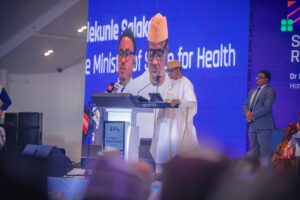
The Minister of State for Health and Social Welfare, Dr Iziaq Adekunle Salako, has announced a 60 per cent reduction in facility-reported maternal deaths in Nigeria compared with 2024, attributing the development to ongoing reforms in the country’s health sector.
Salako made the disclosure on Tuesday in Abuja while delivering special remarks at the opening ceremony of the 2026 Nigeria Health Sector Joint Annual Review (JAR), held at the Transcorp Event Centre, Maitama.

The review, themed “Make the Data Count,” brought together stakeholders across the health sector to assess performance, identify challenges and strengthen accountability in healthcare delivery.
The minister said the Tinubu administration had recorded significant milestones in healthcare financing, insurance coverage, primary healthcare delivery, maternal and child health, as well as local pharmaceutical manufacturing.
He disclosed that nearly eight million additional Nigerians had been enrolled in health insurance under the administration, including more than three million vulnerable persons.

Salako further revealed that the government was directly supporting over 8,000 primary healthcare centres, with utilisation of the facilities more than doubling.
He said over N290 billion had been released for basic healthcare, while more than 3,000 PHCs had been upgraded to Level 2 readiness.
Providing further details on health outcomes, the minister said facility-reported neonatal deaths had declined by 22 per cent, while under-five deaths had dropped by 25 per cent.
He also noted improvements in local pharmaceutical manufacturing, explaining that the proportion of locally produced pharmaceutical products had risen from 30 per cent in 2023 to 50 per cent in 2026.
According to him, the number of active local pharmaceutical companies also increased by approximately 10 per cent within the period.
Salako said these developments demonstrated the impact of the Health Sector Renewal Investment Initiative, which was introduced to address fragmentation, strengthen coordination and improve accountability in Nigeria’s healthcare system.
He explained that the Health Sector Renewal Compact brought government institutions and stakeholders together under the principle of one plan, one budget, one report and one accountability framework.
“The JAR is therefore not a mere ceremony but a working platform to measure performance against the compact, spotlight what works so that others can adopt it, and end with clear resolutions assigned to MDAs, partners and persons responsible, with defined timelines for action,” he said.
The minister disclosed that the 2026 review would examine several critical areas, including reproductive, maternal, newborn, child and adolescent health, food and drug regulation, emergency transportation, free maternal and newborn services, MAMII and healthcare financing.
Other areas scheduled for review include nutrition, non-communicable diseases, local manufacturing and health security.
He announced that the National Sexual and Reproductive Health Policy 2026–2030 and the task-shifting and task-sharing guidelines would also be unveiled during the review.
Salako emphasised that reliable data remained essential to identifying healthcare needs, measuring progress and ensuring that government interventions produced tangible benefits for Nigerians.
He said the establishment of DHIS2 as a reliable source of health information would strengthen evidence-based decision-making ahead of the end-term evaluation of the health sector reforms.
Looking towards 2031, the minister outlined key healthcare targets, including achieving at least 90 per cent functional primary healthcare centres, providing direct quarterly financing to 17,600 PHCs through the Basic Healthcare Provision Fund and enrolling 40 per cent of Nigerians in health insurance.
He added that the government was targeting coverage of all 774 local government areas under MAMII and reducing out-of-pocket healthcare expenditure to below 50 per cent.
While acknowledging the progress recorded, Salako maintained that more work remained to be done, urging stakeholders to translate the review’s resolutions into measurable actions in the 2027 annual operational plans.
He called on federal and state governments, development partners, private sector operators, traditional institutions and healthcare workers to sustain their collaboration in improving healthcare delivery.
The minister stressed that the ultimate objective of the reforms was to ensure that every Nigerian, regardless of location or economic status, had access to quality and affordable healthcare.
