

NCS, Russian Customs Deepen Bilateral Ties, Target Improved Trade Intelligence and Border Security
…Agreement Opens Path for AEO Mutual Recognition, Customs Data Exchange
The Nigeria Customs Service (NCS) has strengthened its international cooperation following the signing of a customs assistance agreement with the Federal Customs Service of the Russian Federation, aimed at improving trade facilitation, information sharing and border security.

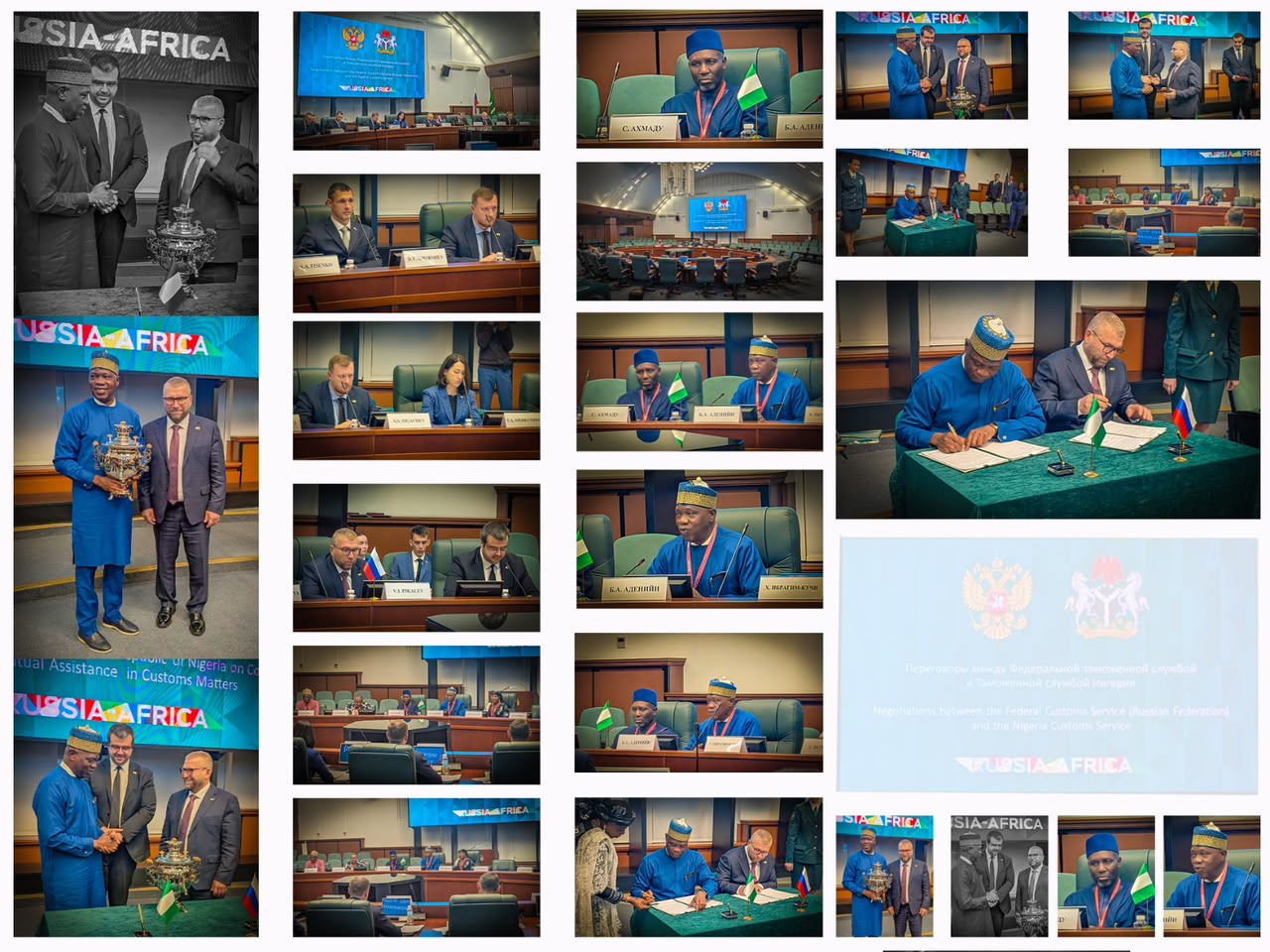
The agreement, known as the Agreement on Cooperation and Mutual Assistance in Customs Matters (CMAA), was signed in Moscow on October 28, 2026, during an engagement between officials of both countries.
Leading the Nigerian delegation, the Comptroller-General of Customs, Adewale Adeniyi, said the agreement would provide a solid foundation for enhanced institutional collaboration, economic protection and the development of more secure international supply chains.
He described the development as the outcome of sustained technical engagements, legal consultations and discussions between the two administrations.

According to Adeniyi, the Nigeria Customs Service has continued to reposition its operations through legislative reforms and digital transformation, particularly following the enactment of the Nigeria Customs Service Act 2023.
He said the introduction of digital systems had significantly improved customs operations, with declarations, payments and the submission of supporting documents increasingly handled electronically.
The Comptroller-General maintained that the Service was committed to balancing revenue collection with the facilitation of legitimate trade, in line with international customs standards.
One of the major areas highlighted during the discussions was the possibility of establishing mutual recognition between Nigeria’s and Russia’s Authorised Economic Operator programmes.
Adeniyi explained that both countries would benefit from exchanging knowledge and operational experiences on their respective AEO programmes before working towards mutual recognition.
He said the initiative would strengthen the confidence placed in businesses that comply with customs regulations and potentially reduce delays in the movement of goods between both countries.
The Nigerian delegation also proposed stronger cooperation in customs statistics and trade data sharing to improve the monitoring and analysis of commercial activities.
Adeniyi disclosed that Nigeria had participated in the World Customs Organisation’s data initiative, noting that the NCS was the only customs administration to submit its trade data to the project.
He emphasised that access to reliable information would enable both countries to identify trade patterns, analyse discrepancies and make informed decisions on customs administration.
In his remarks, the Head of the Federal Customs Service of Russia, Valery Pikalyov, said his country’s customs administration was legally empowered to collect, process and provide statistics obtained from customs declarations.
Pikalyov explained that Russia already exchanged customs statistics with other countries under established cooperation agreements, helping customs authorities monitor trade developments and identify discrepancies.
He expressed readiness to explore a specific arrangement with Nigeria for the exchange of customs statistics, subject to the necessary regulatory framework and procedures.
The Russian Customs chief further noted that Nigeria had joined Ethiopia and Namibia as one of the first sub-Saharan African countries to establish a customs cooperation agreement with Russia.
The meeting, which took place within the framework of the Third Russia-Africa Summit, further demonstrated the growing importance of customs cooperation in strengthening relations between the two countries.
Under the agreement, both administrations will collaborate in four key areas, including simplified customs procedures, intelligence and information exchange, financial integrity and border security.
The framework will also support efforts to combat illicit financial flows, tax evasion, illegal importations, counterfeit products, narcotics and other prohibited or dangerous materials.
Additionally, the agreement provides for direct operational assistance, personnel training and the exchange of technical expertise to strengthen the capacity of both customs administrations.
With the agreement signed, Nigeria and Russia are expected to expand cooperation in customs enforcement, improve trade transparency and create more efficient conditions for legitimate international commerce.
