

Uzodimma Says Tinubu’s Subsidy Removal Caused Hardship for Nigerian Families
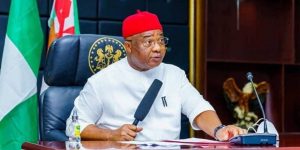
Imo State Governor, Hope Uzodimma, has defended President Bola Tinubu’s decision to remove the petrol subsidy, admitting that the policy brought considerable hardship to Nigerian households as prices of goods and services increased.
The governor spoke on Wednesday at the ongoing World Public Relations Forum in Abuja, where he highlighted the importance of effective communication, stakeholder engagement and public trust in responsible governance.
Uzodimma acknowledged that the economic consequences of the subsidy removal affected many families, even though he insisted that the decision was necessary to protect the country’s overall economic interests.
“Admittedly, many families encountered difficulties when prices adjusted upwards,” he said.
He explained that the previous subsidy arrangement allowed petroleum sector intermediaries to benefit disproportionately, leaving ordinary Nigerians without corresponding advantages.
According to him, the Tinubu administration therefore had to end the regime in the national interest, particularly as Nigerians across different sectors had previously demanded its removal.
The governor, however, cautioned that governments must not overlook the suffering of citizens when introducing major economic policies.

He argued that the additional resources available to the 36 states and the Federal Capital Territory following the subsidy removal could support infrastructure development and other socioeconomic interventions.
Uzodimma stressed that governments must communicate the objectives of their policies clearly to ensure that citizens understand the reasons behind difficult decisions.
To illustrate his position, he used the example of introducing government-operated buses on major routes in Owerri, explaining that although the initiative could reduce transportation costs for residents, it might affect commercial drivers whose businesses depend on those routes.
He said such drivers could be encouraged to explore alternative opportunities, including shuttle operations, car hire services and other transportation routes.
“The same decision that helps many can hurt a few, at least for a while,” he stated.
He maintained that government had a responsibility to ensure that the benefits of public policies reached the widest possible population while supporting those who might experience temporary disadvantages.
The governor also emphasised that public confidence could only be sustained through regular engagement, transparency and a willingness to address citizens’ complaints.
Speaking on his administration’s approach to public relations and accountability, Uzodimma disclosed that he established a quarterly stakeholders’ forum in June 2020, less than six months after taking office.
He said the initiative was designed to provide residents with direct access to government, allowing them to ask questions, criticise policies and demand explanations about government activities.
According to him, although some of the meetings were uncomfortable, they helped his administration identify areas where it had fallen short and address emerging problems before they escalated.
He disclosed that the engagement strategy was subsequently expanded through a radio town hall programme involving more than 20 radio stations across the South-East.
The programme, he explained, provides a platform for residents, journalists, diaspora communities and other stakeholders to engage government officials and seek answers to issues affecting them.
Uzodimma listed some of the concerns raised during the engagements to include students losing admission opportunities, security challenges in rural communities and pensioners seeking clarification about their entitlements.
He described the radio programme as his administration’s annual general meeting with the people who entrusted it with political leadership.
The governor also referenced the Nigerian Institute of Public Relations’ definition of public relations, which recognises the profession as a strategic leadership function responsible for building trust, reputation and sustainable relationships through ethical, transparent and culturally respectful communication.
Citing stakeholder theory developed by American scholar Alfred Edward Freeman, he explained that every individual or group affected by government decisions deserved consideration, whether they benefited from the policies or experienced temporary disadvantages.
He further stressed that governors must personally take responsibility for communicating their administrations’ visions, achievements and policies to the public.
According to him, fulfilling campaign promises and delivering tangible projects remain equally important in building public confidence.
Uzodimma maintained that citizens were more likely to support government policies when they understood the intentions behind them and had confidence in the leadership.
He said his experience in Imo State had demonstrated that trust remained a critical foundation for effective governance and cooperation between government and the people.
“From my engagement with the people of Imo State, I have come to understand that when people trust their government, they are more willing to work with it,” he said.
