

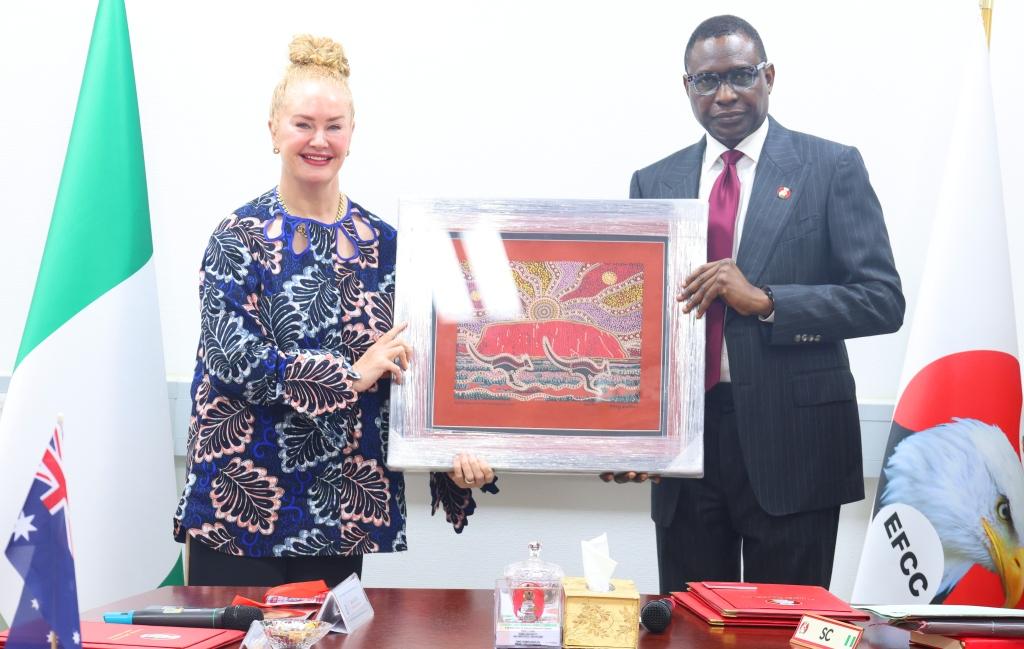
EFCC, Australian Federal Police Deepen Partnership Against Financial Crimes, Cybercrime
Nigeria’s Economic and Financial Crimes Commission (EFCC) and the Australian Federal Police (AFP) have strengthened their longstanding partnership with the signing of a Memorandum of Understanding aimed at tackling cybercrime and other cross-border financial offences.
The agreement was formalised on Wednesday, November 4, 2026, at the EFCC Headquarters in Jabi, Abuja.
The Australian High Commissioner to Nigeria, Leilani Bin-Juda, who spoke at the event, praised EFCC Chairman Ola Olukoyede and the Commission’s personnel for their years of cooperation with the Australian Federal Police.
She highlighted the contributions of both countries to intelligence sharing, technological exchange and professional support, describing the partnership as beneficial to their bilateral relations.
The High Commissioner emphasised that cybercrime was no longer a challenge limited to individual countries but a global threat requiring coordinated international responses.
She particularly acknowledged Nigeria’s influence in the African region, noting that other countries looked up to it for leadership in addressing cybercrime.
Similarly, the Assistant Commissioner of the Australian Federal Police, Sandra Booth, said the agreement would open a new chapter in the relationship between the two agencies.
According to her, the EFCC and AFP have maintained a working partnership since 2004, recording achievements in sensitive investigations, cyber-enabled offences, business email compromise cases, financial investigations and scams.
She expressed confidence that the MoU would strengthen institutional cooperation, encourage professional development and provide fresh opportunities for both organisations to work together.
Responding, EFCC Chairman Ola Olukoyede said international partnerships had become increasingly important because financial crimes were no longer confined by national borders.
He observed that criminal networks operate across jurisdictions, making it necessary for countries to strengthen their cooperation and intelligence-sharing mechanisms to effectively combat them.
Olukoyede described the agreement as a formal framework for expanding the existing relationship between Nigeria and Australia in the fight against economic and financial crimes.
He explained that areas of cooperation would include capacity building, manpower development, mutual support and the exchange of information and intelligence, subject to the laws of both countries.
The EFCC chairman maintained that international collaboration remained essential to ensuring that criminals were brought to justice, irrespective of where their activities originated.
Meanwhile, the Australian Federal Police honoured four EFCC officers for their outstanding contributions to a complex and prolonged investigation.
Those recognised were Assistant Commander of the EFCC II Abba Sambo Usman, Assistant Commander of the EFCC II Olufemi Olukinni, Assistant Commander of the EFCC II Omewa Pius Nnaemeka, and Inspector of the EFCC I Owolabi Jude Oyarekhua.
The awards recognised their investigative competence, professionalism and commitment to duty.
