

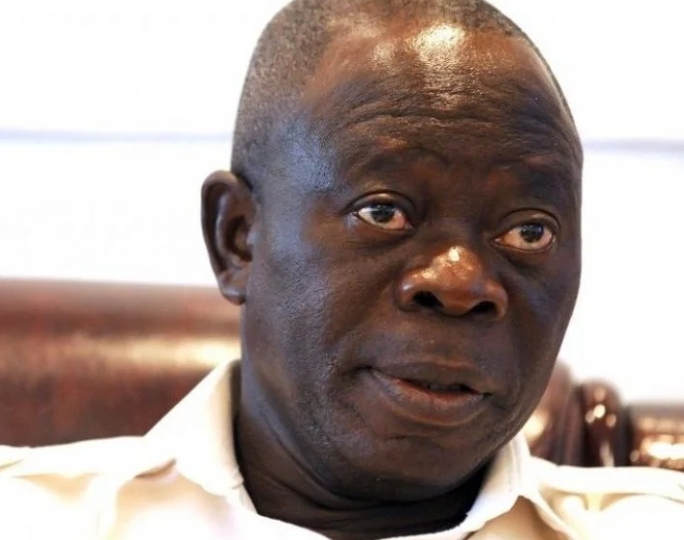
“Enough Is Enough,” Oshiomhole Blasts Akpabio, Questions His Eligibility As Senate President
Senator Adams Oshiomhole has expressed concerns over the eligibility of Senate President Godswill Akpabio to preside over the Nigerian Senate, arguing that the current Senate Standing Order, if strictly interpreted, may disqualify Akpabio from occupying the position.
Oshiomhole, who represents Edo North Senatorial District in the National Assembly, made the remarks during an interview on ARISE Television while reacting to the controversy surrounding the amendment of the Senate Standing Order and the interpretation of “ranking” status among senators.

The former Edo State governor backed the position earlier canvassed by Senator Adeniyi Adegbonmire, SAN, who had questioned the implications of the amended Senate rules, particularly the requirement relating to years of legislative experience and whether such years must be consecutive.
According to Oshiomhole, if the Senate rule requiring a minimum of eight years legislative experience for certain leadership positions is applied strictly, Akpabio himself may not meet the qualification threshold.

“Yeah, what SAN Adegbonmire said is correct, and that is why I said the fight is not over,” Oshiomhole stated during the interview.
“Because even the current Senate President, Godswill Akpabio, did four years. Subsequently, he lost election to the Senate, and he became a minister.
“Now, he came back this term, and he became Senate President. If you add the first term plus the current one, he would not have done eight years.”
The senator argued further that Akpabio’s previous tenure in the Senate cannot automatically qualify him under the amended rules because his service was interrupted after he lost reelection and later served as a minister before returning to the upper legislative chamber.
“Indeed, he’s probably doing the four, five, six, maybe he’s approaching several years now,” Oshiomhole said.
“So if eight years is a minimum requirement, he doesn’t have the right to preside because he has not acquired the qualification. If he got it in error, it has to be corrected. So that is why you don’t make laws with people in mind.”
Oshiomhole also faulted the interpretation of the word “consecutively” in the amended Senate Standing Order, insisting that the rule unfairly targets some former lawmakers and principal officers who had interrupted legislative careers but later returned to the Senate.
“Number two, there is another thing that Adegbonmire did not amplify, and that is the word consecutively,” he said.
“If you say consecutively, it means the first tenure of distinguished Senate President Akpabio in the eighth Senate will not count because he was not in the ninth Senate, and therefore is not consecutive.
“Strictly speaking, by the interpretation of the rules that have been made, he has only done — he’s approaching three years as a Senator for the purpose of ranking.”
The senator maintained that the amendment does not add value to the legislative process and warned against tailoring laws to favour or exclude specific individuals.
“I hold the view that this is just, for me, is not adding value to the process,” he stated.
“Not to stop any Senator from being Senate President for as long as first his people elect him or re-elect him, and his colleagues accept him. There is no shortcut to it.”
Drawing comparisons with former Senate President David Mark, Oshiomhole said legislative leadership should be based on trust and acceptance by fellow lawmakers rather than technical amendments designed to restrict eligibility.
“That is why I gave an example of distinguished Senator David Mark,” he said.
“He held that office for eight years, and all he needed to do to hold the office for eight years was to earn and sustain and service the trust line between the Senate Presidency and the distinguished Senators.
“Often times, you will hear David Mark saying, ‘the Senators are my bosses’ because they elect me, because the only right you have is the one your constituency confers on you, namely to be a Senator.”
Oshiomhole further stressed that the office of Senate President should not be elevated above democratic accountability to fellow senators.
“To be a Senate President, you are first among equals,” he declared.
“And you know where we turn our back and allow small, small things to happen? That is how Africans produce dictators that become bigger than their own country.”
The lawmaker insisted that his comments were not driven by personal hostility toward Akpabio, whom he described as his friend, but by concern for democratic principles and institutional integrity.
“That was just my point, nothing personal about it,” he said.
“Akpabio was my friend. But anybody who knows me knows that my friendship is important. But the country is much more important than my personal relationship with anyone.”
Oshiomhole also cited other politicians who could be affected by the amended rule if legislative service must be consecutive before a senator can be regarded as ranking.
He referenced former Deputy Senate President Ovie Omo-Agege and former Delta State Governor Ifeanyi Okowa as examples of politicians whose prior legislative experience could become invalid under the interpretation being proposed.
“For example, I know that what has informed that rule is the most publicized fact that there are a couple of former Senators,” Oshiomhole said.
“Perhaps the most compelling case would be that of Senator Omo-Agege, who was a Deputy Senate President. Now he comes back to the eleventh assembly, assuming he wins.
“And then you say he’s no more ranking, because it is not consecutively.”
“Or Senator Okowa, who was a Senator before going to become Governor. Exactly the same way as distinguished President Akpabio was a Senator, and then he lost an election, he became a Minister, and then came back to contest and become Senator again.”
According to him, the amended rule could prevent experienced lawmakers from occupying even principal offices within the Senate.
“And he was considered as ranking. Now this amendment says that once it is not consecutive, you are not ranking.
“You cannot even be, not just Senate President, you cannot even be a Principal Officer. How fair is that?”
The former labour leader warned lawmakers against enacting laws motivated by fear of future political opponents, saying such practices undermine democracy and encourage authoritarian tendencies.
“I’m just saying that, you know, as a matter of morality, you don’t make law either for yourself or make law against specific individuals that you fear will come,” he said.
“That is the road to life presidency and dictatorship. That’s why our neighbours can elect a 93-year-old man in Cameroon, and a 97-year-old man.
“That for me, those are the issues, nothing personal.”
