

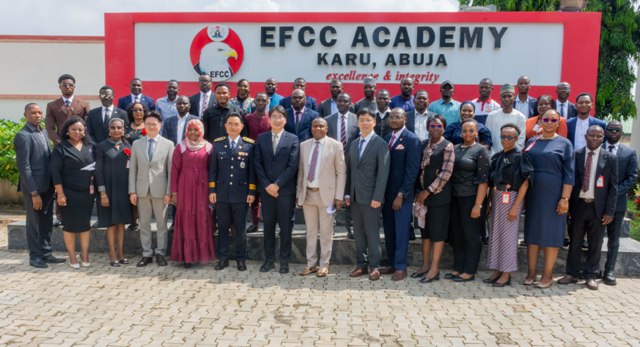
EFCC Partners South Korean Police To Train Operatives On Crypto Crime, Asset Recovery
The Economic and Financial Crimes Commission (EFCC) has partnered with the South Korean Police to train more than 30 of its operatives on asset tracing and cryptocurrency investigations as part of efforts to tackle increasingly sophisticated financial crimes.
The 10-day training programme commenced on Tuesday, October 13, 2026, at the EFCC Academy in Karu, Abuja.
Speaking on behalf of EFCC Chairman Ola Olukoyede, the Acting Commandant of the Academy, Assistant Commander of EFCC Joseph Ogwiji, said the increasing adoption of digital financial services and virtual assets had created a need for investigators to continuously upgrade their skills.
Ogwiji noted that criminals were exploiting emerging technologies to commit fraud, move illicit funds and hide their identities, making technically sound and lawful investigations necessary.
He added that the growing cross-border nature of financial crimes and money laundering required investigators to understand digital transaction records, trace funds across platforms and connect electronic evidence to suspects.
The Consul and Police Attaché at the South Korean Embassy in Nigeria, Eun-pyo Hong, said the programme was the Korean Government’s first training initiative of its kind in Africa.
He explained that the initiative coincided with the first anniversary of the cooperation agreement between the EFCC and the Korean National Police Agency, signed in Seoul in October 2025.
According to Hong, the partnership reflects the commitment of both institutions to strengthening cooperation in the fight against financial crimes.
The agreement provides for information sharing, the exchange of investigative best practices, institutional development, asset recovery coordination, public education, research collaboration and joint training initiatives.
The South Korean delegation, led by Woosung Kwon of the Korean Police Investigation Academy, expressed appreciation to the EFCC management for its hospitality and cooperation.
Kwon observed that criminals were increasingly relying on cryptocurrency, cross-chain technology and the dark web to conceal financial transactions and evade law enforcement agencies.
He emphasised that international collaboration was crucial because cryptocurrency-related crimes were not restricted by national boundaries.
The training will feature practical sessions on open-source intelligence techniques, cryptocurrency tracing, identifying digital financial leads, recovering assets and preparing evidence for court.
Also speaking, the EFCC Head of External Cooperation, Aliyu Wali, said the programme would improve the ability of investigators to trace, analyse and investigate virtual asset transactions.
Wali, represented by Assistant Commander of EFCC Michael Kayang, described the training as an important step towards strengthening the Commission’s response to cyber-enabled financial crimes.
He encouraged participants to maximise the opportunity to learn from their South Korean counterparts and apply the skills acquired in their investigations and asset recovery operations.
